

First off is calculating the exposure for what avalable light there is. Selecting a shutter speed of 1/200th to avoid shake, then choose the maximum aperture of F4, after all it is pretty dim out there and detail of the garden wall is required. Well, not really but we'll pretend that it is.
As the results were way too dark at ISO 200 we decided on 1250 ISO as noise is not too much of an issue with a Canon 70D and Lightroom and the results don't look too bad, but by adding a flashgun we could do better.

 Now to create the sunlight. A flashgun is attached to a tall light stand
in the backyard and a CTO (Colour Temperature Orange) filter is placed
over the flash lens to warm up the light.
Now to create the sunlight. A flashgun is attached to a tall light stand
in the backyard and a CTO (Colour Temperature Orange) filter is placed
over the flash lens to warm up the light.With the flash aimed at the kitchen window to be our pretend sunlight we'll retreat indoors and see how it looks in camera. To bright so we reduce the power setting to 1/2.
The white balance is left on the flash setting on the camera which creates a very pleasant warm glow.
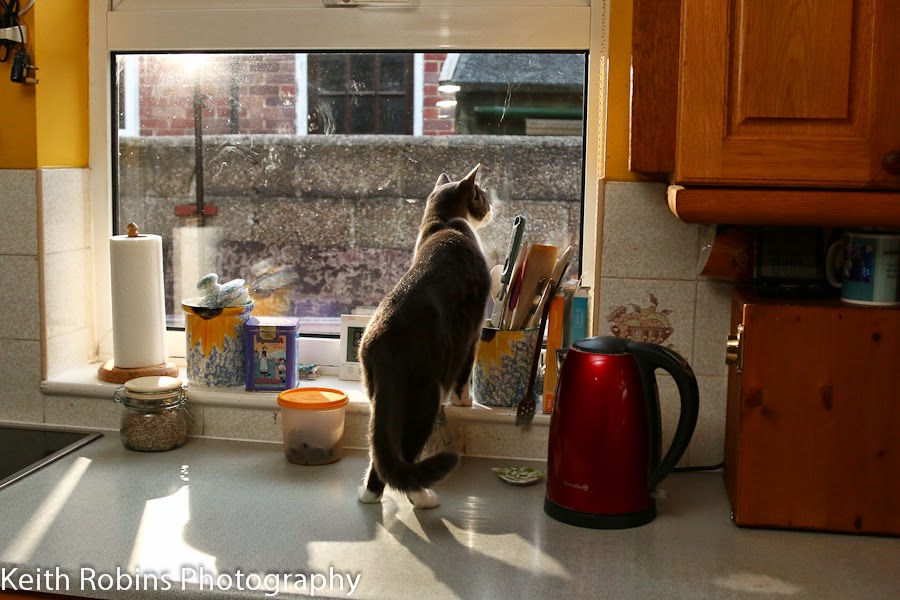
Adjusting our outdoor flash power to match ISO 1250 at F4 produces the resulting image below and looks a lot more natural, just like a summer's day!

However, the rest of our kitchen now seems a little dark compared to the new sunlight coming through the window, so a second flash is aimed at the ceiling well away from the window to make it seem as if the sunlight is strong enough to bounce around the room, which it would do in reality. We now need to find the cat again who by this time is settling into his basket and by pointing out the birds sat on the garden wall Socks is quite happy pose for another portrait.
Both flashguns are operating on iShoot radio triggers from China at £55 for three triggers and a transmitter. A setting of 1/128th power is all that is required for the indoor flash and 1/2 power for the outside one. The signal for these radio trigger will bounce around a room in every direction and rarely cause a misfire. but outdoors they only work line of sight up to 50 metres easily. The outdoor trigger is hidden by the flashgun body so a small piece of silver foil is attached to bounce the radio signal at the trigger.
For those who have two sets of radio triggers ti's possible to join a receiver and transmitter together and place this combination in a position where it's visible from both camera and hidden trigger.
Alternatively, a Yognou flashgun would be an option as they have an optical triggering system built-in, but again it has to be line of sight and a third flash on a radio trigger might be required to fire the outside flash.
All in all a very rewarding thirty minutes playing with flash.


