
 Popstar and strobist, Keith Robins Photography, in the bluebells!
This late evening popstar photoshoot required three flashguns, nothing technical though as time was short.
We were also short of an actual popstar so Trevor leaped in with a borrowed guitar.
Photo one gives an idea of the location and the little Vivitar 285HE of which I used two. These run on 6 volt motorcycle batteries as they are allergic to rechargable AA's. Third gun was a Miranda from Ebay at £2 which does run on rechargables. I've got two of these lovely little Miranda's and use them a lot.
 All the lighting stands, camera kit and other parphinalia we strobists think we really need, but hardly ever use, is carried in a kitchen waste bin fixed to a collapsible trolle with gaffer tape and bungee straps and is seen here standing in for Trevor while he puts on one of my old movie making wigs.
The trolley wheels folded up on the last photo trip and the weighty kit had to be carried back to the van. The buggy has since been adapted with a solid bar axle for just £2, but at only £12 from Maplins for the trolley I still ended up with a bargain.
 I wanted our lively popstar to leap in the air and look as if he's bellowing a few lyrics - He's a few years younger than myself so his knees can take the strain. A tip for those with spare cash and the means to transport it - how about a three foot diameter trampoline from Ebay for twenty quid?
Mounting the flashes onto a Bowens stand, an Elinchrom and an Interfit stand, (Yes I like variety), requires the use of hotshoe to lighting stand adaptors at £6 each off the internet. As nothing we strobists use ever seems to be compatible I've Araldited a DIY metal hotshoe foot on top of each of my flashguns, including my two Canon 580 EXlls, which has the bonus of bringing the flash window right next to a brolly shaft.
But then the breeze catches one of the brollies and a few swear words spring to mind. I now carry a tube of superglue and a few spare brollies.
By keeping one flash in shot the illusion of an outdoor stage venue was a last minute addition which we both liked, then decided that adding a CTO filter made it resemble the sun setting through the backdrop of trees, which we liked even more.
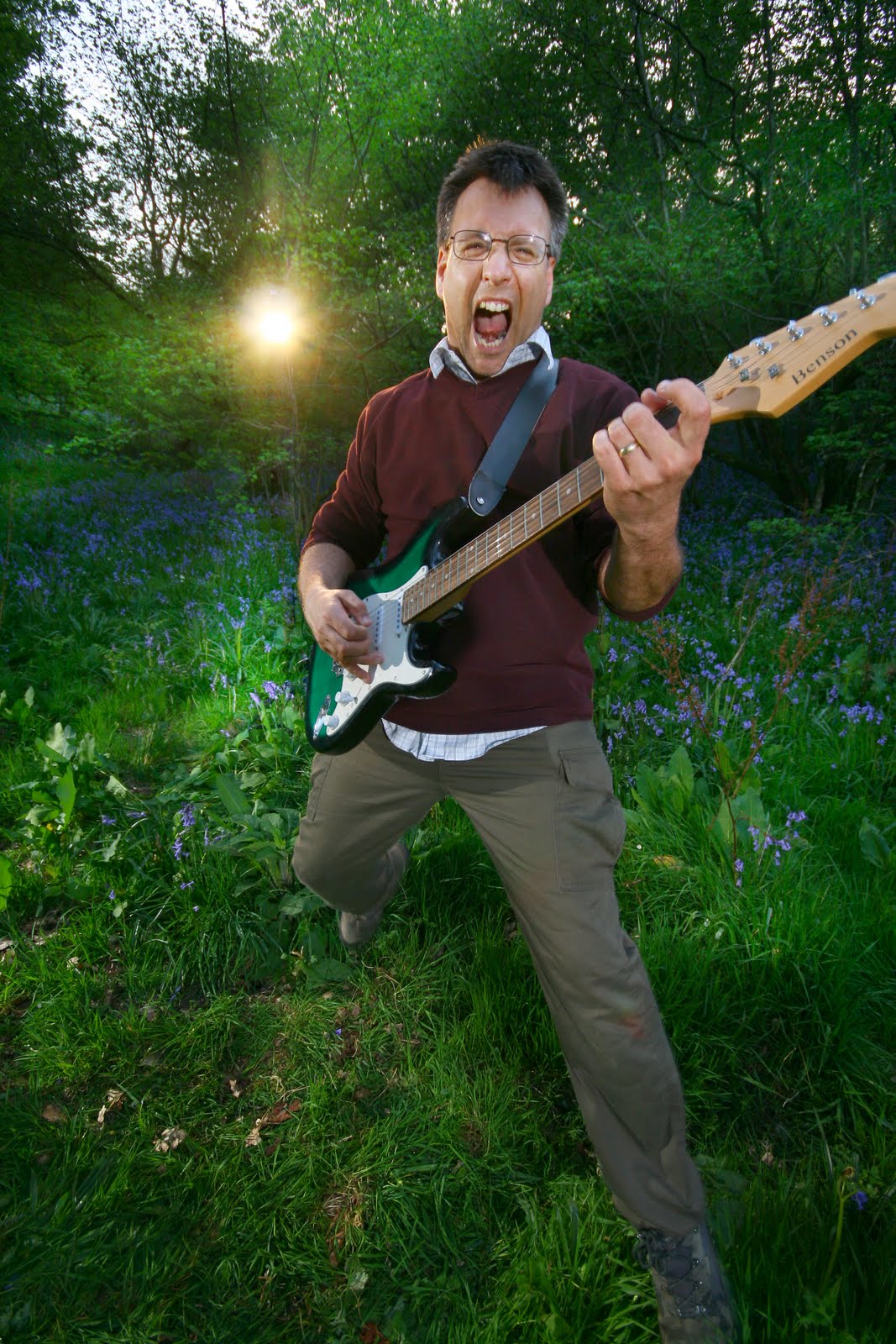 To retain the daylight level, which revealed detail in the bluebells, I used ISO 400 and a shutter speed of 1/80th. I did try 1/20th at F8 but the resulting blur was too distracting plus it darkened the flash too much.
Remember, shutter speeds control daylight and apertures control flash strength - higher shutter speed makes the sky/background darker and lower makes it lighter. ISO changes effect both flash strength and daylight levels so I usually leave the sensitivity set on 100 ISO.
Although the aperture effects both ambient and flash it is primarily the flash strength which is controlled via the F numbers - higher F number darker flash. Of course you could always move the flashgun further away to decrease the strength, or turn down the power setting.
I'm not going to go into how to use highspeed shutter sync right now as cameras and flashes vary so much. Best to study the techniques of this along with multiple dedicated flashes in your flashgun instruction book.
Of particular interest is the Nikon CLS (controlled lighting system), or the Canon equivalent. I've used multiple hotshoe flashguns for thirty five years and find the process simple, straight forward and easy - but these dedicated lighting systems are something else! Bear with me though and when I have sussed out how to use it successfully I'll pass the info on in this blog.
 Meanwhile, an aperture of F5.6 returned the best images making full use of the three flashes, of which the Vivitars were set to 1/16th power at six feet front and back and the Miranda on full power at around twenty feet. Keeping all the flashes in sync was an IShoot radio transmitter on the camera sending radio signals to a set of three IShoot receivers on the three flashguns.
 I bought this set of Ishoot triggers and the transmitter for £60 from a fellow photographer who wanted a Nikon fit, but then he found there is only Canon fit available.
I've since used these same triggers with Nikon, Olympus and my Canon cameras with equal success as I'm guessing all the little contacts don't actually do anything. They also work superbly with my Elinchrom studio lights and having four channels is a real boon in a busy studio environment.
Meanwhile Trevor is having a ball, leaping and shouting and I'm loving how these three amazing strobes are working together - absolutely wonderful lighting!
 Okay so next time we'll add a few more coloured filters and maybe a smoke machine, maybe even try adding a real sun filtering through the trees along with a studio flash to really challenge the sun's strength, but being an emergency plumber means time is often short.
Thank you Trevor for being a great sport and he says he is available for bookings, but don't ring him - he'll ring you.


